The Inherited Fiction
Lesson video in production
The full lesson text below is complete — the video version lands with launch.
The Inherited Fiction
Now the other column. These are the losses that feel exactly as heavy as the real ones and evaporate when you hold them up to the light. The trick is that each one arrives wearing the costume of prudence. One at a time.
"You're overqualified." Overqualified is badge-speak; it only means something inside the badge economy. Out here it has no referent. For the trade you are underqualified, exactly like every apprentice in the history of apprenticeships, and the trade has a system for that: you get taught, slowly, by people who know. Meanwhile there's a second system running in your favor that the sentence never mentions. Service businesses are full of excellent hands and starving back offices. The operator who can do the work and write the estimate, read the contract, run the schedule, and bill on time is rare enough that desk skills are a competitive weapon. You're not overqualified. You're wrongly qualified for eight months and then unusually qualified for the whole business, as opposed to one lane of it.
"You wasted your degree." This one has two answers and you'll need both. First, sunk cost: the tuition is spent. Every path forward costs the same ten years regardless of what the previous decade contained. "Wasted" imagines the degree stops working unless you keep feeding it a desk. It doesn't work that way.
Second, the market already ruled on this, and the ruling is recent. The Federal Reserve Bank of New York tracks what happens to graduates: as of the second quarter of 2026, 42 percent of recent college grads were underemployed, meaning they work jobs that typically don't require a degree at all. Read that again with the sentence in mind. The badge economy has been awarding degrees and then not awarding desks, to more than four in ten of its own winners, for years.
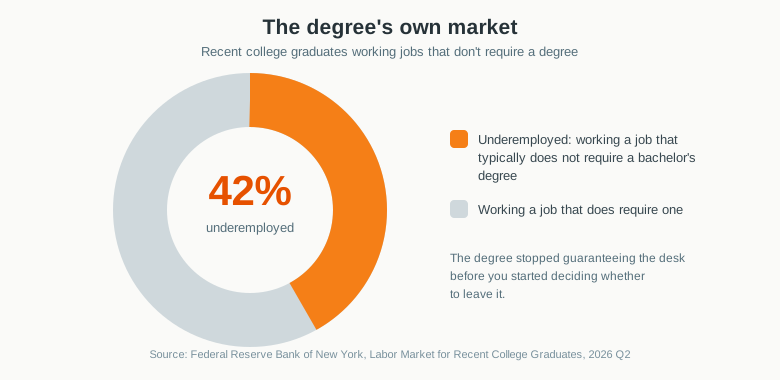
The degree stopped being a desk guarantee a long time before you started deciding whether to leave the desk. Leaving for the trades does not waste it more than the underemployed graduate "wastes" it answering phones. And unlike the underemployed graduate, you'd be carrying it somewhere it's scarce: into an industry where the written estimate wins the job.
"People like us don't do this." You know exactly where this one came from now; we took its whole genealogy apart in Where the Sentence Came From. I'll add only this. Inherited fiction passes down without anyone signing for it. Nobody in your family convened a meeting and voted that trade work is beneath your line. The feeling compiled itself out of eighty years of ambient messages and presented itself as family wisdom. You are allowed to decline an inheritance you never asked for. People do it with money all the time. This is easier.
"My parents sacrificed so I could sit at a desk, not climb under a sink." The hard one. I won't pretend it dissolves in a paragraph, because for some readers it's the heaviest sentence in the whole guide. But look at what the sacrifice was actually for, because there are two readings and they lead different places.
In the first reading, the sacrifice was about escape: from precarity, from bosses who could end you with a signature, from work that broke bodies and paid nothing reliably. If that's the sacrifice, then a licensed trade with a median wage north of sixty thousand and your own name on the work honors it completely. The escape your parents bought is precisely the position you'd be standing in: safe enough to choose.
In the second reading, the desk was the trophy itself. The sacrifice bought the badge, specifically, as proof. If that's your family, then leaving costs something real, a kind of grief, and I'm not going to talk you out of it here. That conversation gets its own treatment later in the course, scripts included. But hold onto one distinction while you carry it: you were not required to live as someone else's trophy. You can love the people who sacrificed and still decline to spend your one working life as the receipt for it.
That's the fiction column, cleared. Losses that were real got named in the last lesson, and the fiction just got retired. What's left is the question the sentence was always guarding: what actually happens to your standing when the badge comes off.
Keep going — you're working through The White-Collar Exit.
All courses are free ↗