What Happens to Your Status
Lesson video in production
The full lesson text below is complete — the video version lands with launch.
What Happens to Your Status
Underneath the sentence, underneath the money worry and the parent problem, sits the real question: will I fall? As in, will I walk into a room and be less than I was. That fear deserves a mechanic's answer, not a pep talk, because status actually behaves in knowable ways and the knowing helps.
There are two status currencies in working life. Credential status is what you're issued: the degree, the title, the employer's name. Competence status is what you earn in front of witnesses: can you do the thing, this week, in this weather, with this customer watching. The badge economy pays in the first currency and performs the second in meetings. The trade economy pays almost exclusively in the second. Nobody asks the electrician where they went to school; they ask when the power comes back on.
Your fear is a currency conversion problem. You are leaving an economy where you're rich and entering one where you start at zero, and the fear says: therefore I fall. But currencies convert, and here is the exchange in the order it actually happens.
Week zero: the announcement dip. The badge comes off and the standing reads as zero, because for a moment it is. The dip is real, it's the lowest point of the whole transition, and everyone I've ever heard describe this crossing describes some version of it. Expect it. It is not evidence the decision was wrong. It's the exchange rate's opening position.
Weeks one through eight: you're the slow one. This has a specific humiliation temperature for people who spent a decade being competent at things, because you chose to become a beginner on purpose. You will be bad at physical things you assumed were easy, in front of people younger than you who are better at them. Let that be what it is: tuition.
Months three through twelve: competence accrues. First solo job. First customer who calls back instead of shopping you. First time a stranger asks your opinion at the counter and waits for the answer. Standing starts compounding in the new currency, and it compounds faster than the badge economy ever let yours grow, because the witnesses are multiplying: every finished job is a room you now have standing in.
Year two and after: the new equilibrium. Your standing now exists in rooms the badge never entered: the customer's kitchen, the supplier's counter, the other crews, the neighborhood. And here is the structural difference that matters most. Credential status is rented. A company can take the title back with a Tuesday email, and all that silent vouching evaporates, which is exactly what a layoff is. Competence status is owned. It cannot be demoted, reorganized, or emailed away. It's nailed to your hands.
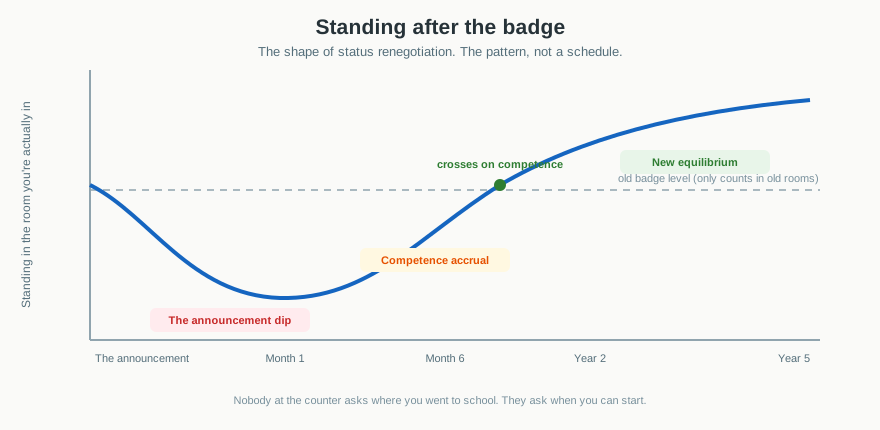
Two honest footnotes to that curve.
First, this isn't my theory imposed on your future. The career-changer threads on the trades forums tell this same shape over and over: the recurring "anyone get into a trade after forty?" and "how many regret it?" discussions on r/skilledtrades and its neighbor subreddits, where former desk workers report with striking consistency that the humiliation expired faster than they feared and the work itself held up. The same threads carry an equally consistent counterpoint: the physical toll is real and underrated, especially after forty. Believe both. The status curve bends up; the knees are not a rumor. Choose your trade with your body in the room. That requirement comes back later in the course, with the rest of the fit questions.
Second, the room you're walking into is not the room from the memo. The contractors' association that tracks this workforce reported in 2025 that the median construction worker is now younger than 42, for the first time since 2011. The stereotype of a trade jobsite as a wall of retiring men in their late fifties is a decade stale. You will not be the only newcomer, and increasingly not the only career-changer either.
And self-respect, specifically, since that's what this whole crossing is really about: self-respect built on a title was always rented from the org chart. Self-respect built on competence is yours, and ownership work makes it legible: the finished job carries your name in a way no deliverable in a shared drive ever did. That's not motivational language. It's the difference between the two currencies.
Status was one thing the sentence guarded. Money is the other, and it deserves the same unsentimental look.
Keep going — you're working through The White-Collar Exit.
All courses are free ↗