Running the Loop: Reorders, Stockouts, and Storage Fees
Lesson video in production
The full lesson text below is complete — the video version lands with launch.
A product that survives launch enters a different game. The launch asked whether it sells. The loop asks whether you can keep it selling without your cash, your rank, or your nerve breaking.
The reorder point, done properly
Replenishment is not fast. From reorder decision to sellable stock in Amazon's warehouse: production two to six weeks, ocean freight about forty days, receiving up to two weeks. Call it sixty to ninety days door to shelf. So you reorder not when stock looks low, but when remaining stock will last roughly as long as the pipeline:
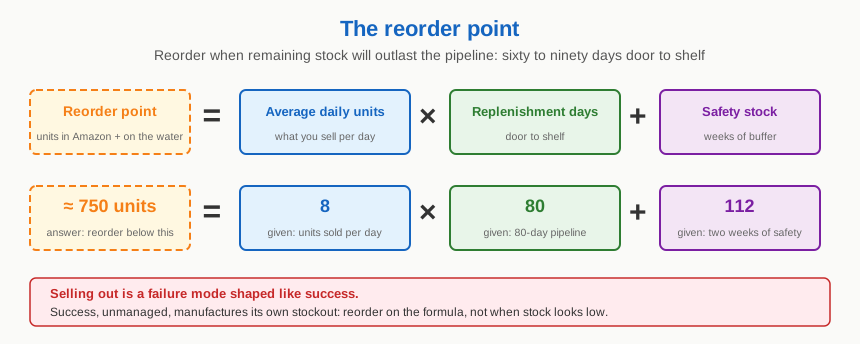
Selling eight units a day with an eighty-day pipeline and two weeks of safety stock: reorder when inventory in Amazon plus on the water drops below about 8 × 80 + 112, roughly 750 units. That number will feel enormous the first time you compute it. It is the honest size of a real replenishment loop, and it is why the cash-conversion cycle from "The Cash-Conversion Cycle" never stops governing this business: every dollar you earn wants to be sent back to the factory immediately, and growth means the loop swallows ever more cash.
Stockouts: the expensive silence
Run out of stock and two bad things happen. The obvious one: you earn nothing while competitors absorb your sales. The quiet one: your rank decays, because the algorithm reads zero sales as zero relevance, and operators consistently report that climbing back after a stockout costs more than the inventory you saved. New sellers discover the perverse incentive this creates: selling out is a failure mode shaped like success. The reorder point exists precisely because success, unmanaged, manufactures its own stockout.
The storage fee machinery
Amazon charges rent on slow boxes, and the machinery has three gears.
Monthly storage runs per cubic foot, roughly $0.80 to $2.40 depending on month and size tier, with October through December priced near the top of the range. Small products hide their volume; oversized ones wear it.
The low-inventory fee punishes the opposite extreme. When both your thirty-day and ninety-day supply averages drop below twenty-eight days of stock, Amazon adds a per-unit fee, in the neighborhood of $0.32 to $2.09 per unit, on the theory that chronically thin inventory hurts its fulfillment promises. New Professional sellers are exempt for their first 365 days after Amazon receives their first inventory, and new-to-FBA parent products are exempt for their first 180 days when you are enrolled in FBA New Selection. Either way, your launch window is protected. Outside those windows, Amazon charges you for holding too little and too much, and the free space in between is narrow.
The aged inventory surcharge kicks in on units aged 181 days and older, stacking on top of monthly storage. Dead stock does not just sit; it compounds.
The weekly fifteen minutes
Once the loop runs, the rhythm is short: check sell-through against the reorder point, check account health, scan the storage fee dashboard for anything aging, and keep the supplier thread warm, because the factory that already made your product is the cheapest and fastest reorder you will ever place.
Next, the human layer: what this work actually feels like at month one and at month six, hour by hour.
Downloads for this lesson
Keep going — you're working through Sell on Amazon FBA: Private Label.
All courses are free ↗