The Honest Money Math
Lesson video in production
The full lesson text below is complete — the video version lands with launch.
Start with the wage data, because it sets the floor of the conversation. Home appliance repairers employed by companies earn a median of about $47,170 a year nationally, around $22.68 an hour, with the top quarter above roughly $59,000. If you go into business to escape a $47,000 job, understand that in year one you may work harder for similar money while you build the asset: a route of repeat customers that pays like a business instead of a job. The transition guide's runway math exists for exactly that comparison.
What a call pays
The unit of revenue is the service call. Typical diagnostic fees run $75 to $125, and completed repairs most often land between $108 and $251 with a national average near $179. Labor rates in the field average around $54 an hour, though flat-rate quoting, covered later in the course, is more common than hourly billing. Parts add a second revenue stream: industry practice marks parts up roughly 30% to 100% over cost, with small parts marked up more and expensive parts less.
Gross margin benchmarks for appliance repair businesses run 45% to 55% on service labor and 35% to 45% on parts-heavy jobs. Run the average ticket through those margins and the two kinds of calls separate fast. Homeowners commonly pay about $200 for a repair, which at a 45% to 55% service margin leaves roughly $90 to $110 of gross profit on a customer-pay call. A warranty job pays the other way: the network sets a negotiated flat rate, and operators who run that work report flat rates of $75 to $100 per job with no extra pay for repeat trips and warranty pay around $120 to $130 with nothing from parts. That gap is not a rounding error, and you will meet what it does to a new route later in this course.
The number that kills beginners
None of those figures matter if you misprice your scarcest resource, which is not parts or tools. It is the working hour. The trap is dividing revenue by repair hours and feeling rich.
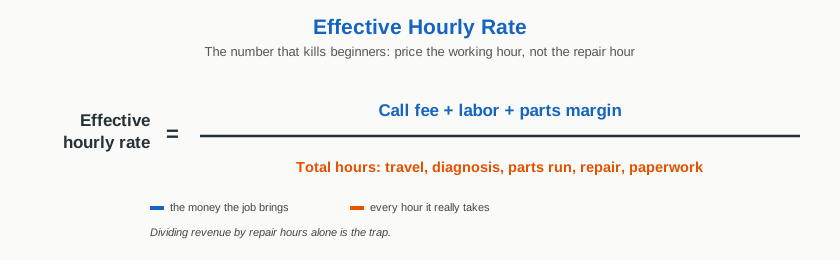
Run a real week through it. Twenty completed calls at $160 average ticket with a 40% blended margin produces $1,280 of gross profit. But those twenty calls consumed roughly fifty-five hours all in: two hours a day of driving, five hours of parts runs and paperwork, and the rest on wrenches. Divide $1,280 by fifty-five and that is $23 an hour, which is less than the median employee wage, before self-employment tax and insurance. The same week with tighter routing, a $185 average ticket, and parts runs consolidated to twice weekly is a different business entirely.
The cash-flow shape: buy Monday, get paid Thursday
This business has a working capital rhythm unlike lawncare or cleaning. You diagnose on Monday, buy a part on your card Tuesday for $85, complete the repair Thursday, and collect $235. Multiply that across a busy week and you are floating several hundred dollars of parts continuously. Two rules keep it harmless: never order a part you have not proven failed with a test, and keep a float, even $500, dedicated to parts purchases so a busy week never depends on your rent money. The ordering discipline that keeps float small gets its own treatment later in the course.
What to measure from day one
Four numbers, tracked in a spreadsheet, tell you the truth about your business within a month: completed calls per week, average ticket, effective hourly rate, and callback rate. Callbacks deserve their own column because they are the silent profit leak; a job you redo for free costs you the parts, the hour, and a piece of your reputation. Everything in the diagnostic method ahead exists to keep that number near zero. None of those numbers is under threat from software, for what it is worth: this course carries a three out of ten on AI exposure, per the catalog's AI-exposure method, because the paid work is diagnosis done in person with hands and a meter, and the parts a machine can run, scheduling and invoicing, are the parts you want run for you.
Money understood, the craft begins. The skill with the biggest payoff in this trade is diagnosis done right the first time.
Downloads for this lesson
Keep going — you're working through Start an Appliance Repair Business.
All courses are free ↗